The Freeze-Thaw Cycle is Ruining Your Masonry: 3 Warning Signs St. Louis Homeowners Should Look for Every Spring
St. Louis Stone & Brick • November 12, 2025
Living in the Midwest means adapting to weather that changes on a dime, but few realize the silent toll these fluctuations take on the structural integrity of their homes. As we transition from the harsh cold to the wet spring, St. Louis homeowners must be vigilant about the health of their exterior hardscapes. The ‘freeze-thaw cycle’ is not just a meteorological term; it is the single greatest enemy of your masonry work. Every year, this natural phenomenon causes thousands of dollars in damages to chimneys, retaining walls, and patios across the region, turning minor hairline cracks into structural liabilities.
The Physics of Destruction: Understanding the Freeze-Thaw Cycle
To understand why your brick and stone deteriorate, one must understand the basic physics of water. Unlike most substances, which contract when they freeze, water expands. Specifically, water increases in volume by approximately 9% when it transitions from liquid to solid ice. This expansion creates tremendous hydraulic pressure up to 100,000 pounds per square inch in confined spaces.
Masonry materials like brick, concrete, limestone, and mortar are porous. They naturally absorb moisture from rain, snowmelt, and humidity. In a climate like St. Louis, where winter temperatures frequently oscillate above and below the freezing point (32°F), this process happens dozens of times a season. Water seeps into the microscopic pores of the stone during the day when the sun is out, and at night, as temperatures plummet, that water freezes and expands. This internal pressure micro-fractures the masonry from the inside out. Over time, these micro-fractures connect, leading to visible and often severe degradation.
While high-quality masonry is built to withstand some environmental stress, the unique volatility of Missouri weather accelerates this process significantly compared to other regions. If you reside in historic areas like Webster Groves or University City, your older, softer brick requires an even keener eye for detail during your spring inspection.
Here are the three undeniable warning signs that the freeze-thaw cycle has compromised your home’s masonry.
Warning Sign #1: Spalling (The ‘Popping’ Face of Brick)
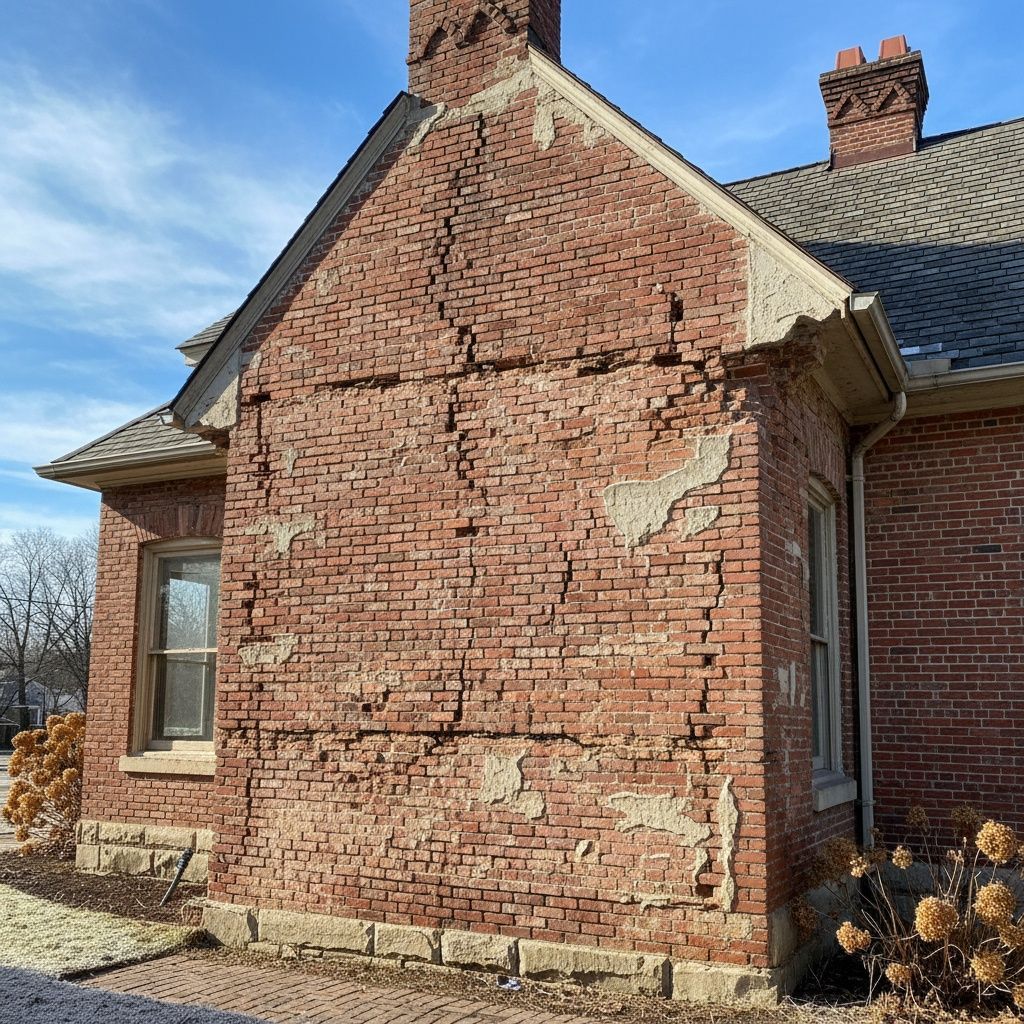
Spalling is perhaps the most visually arresting sign of freeze-thaw damage. It occurs when the face of a brick or stone crumbles, flakes, or pops off entirely, exposing the rougher, softer interior of the unit. This is not merely an aesthetic issue; the outer layer of a brick (the ‘fire skin’) is the hardest and most weather-resistant part. Once that face is gone, the interior deteriorates exponentially faster.
The Mechanism of Spalling typically happens when the brick is saturated with water just before a hard freeze. The ice crystals form near the surface, pushing the face outward until the shear strength of the clay fails. This is often seen near the ground level where splash-back from rain occurs, or on chimneys where the chimney crown has failed, allowing water to saturate the stack from the top down.
If you have
stone brick veneer or specific types of sedimentary stone like sandstone or limestone, spalling can manifest as delamination where the stone peels away in layers like an onion. Ignoring spalling allows moisture to penetrate deeper into the wall cavity, potentially rotting wood framing or rusting steel lintels behind the masonry.
Warning Sign #2: Deteriorating Mortar and Step Cracking
The mortar joints are the sacrificial lamb of any masonry assembly. They are designed to be slightly softer than the surrounding brick or stone to absorb movement. However, because they are porous, they are highly susceptible to freeze-thaw erosion. When inspecting your home this spring, run your hand (or a key) lightly along the mortar joints. If the mortar turns to dust, crumbles away, or if you see visible gaps, the bond has been broken.
The Need for Tuckpointing When mortar joints crack or recede, they create a ledge that catches more water, feeding the freeze-thaw cycle further. This is where professional tuckpointing becomes essential. Tuckpointing involves grinding out the damaged mortar to a uniform depth and replacing it with fresh, compatible mortar.
Critical Note: Using the wrong type of mortar (e.g., using ultra-hard Portland cement on soft historic brick) can disastrously trap moisture, causing the bricks themselves to explode during the next freeze. This requires the ‘Old World’ knowledge of material compatibility that we detail in our guide to
European style stonework.
Look specifically for ‘step cracking’ cracks that follow the zig-zag pattern of the mortar joints. While often caused by settling, freeze-thaw cycles exacerbate these cracks by wedging them open with ice accumulation (ice lensing), eventually leading to structural instability.
Warning Sign #3: Displacement and Heaving
The freeze-thaw cycle affects not just the masonry units, but the ground beneath them. In St. Louis, our clay-heavy soil holds water tenaciously. When the ground water freezes, the soil expands (frost heave), pushing everything above it upwards. When it thaws, the soil contracts and softens, causing structures to settle.
This movement is devastating for horizontal masonry applications like concrete patios, paver walkways, and most notably, retaining walls.
Signs of Heaving to Watch For:
Uneven Pavers:
If your once-flat patio now has trip hazards or pooling water, the sub-base has likely been compromised by frost heave.
Bulging Walls:
Retaining walls often fail because the drainage behind them is clogged (or non-existent). Water gets trapped behind the wall, freezes, and pushes the wall outward. Once a wall begins to lean or bulge, it loses its structural geometry and usually requires rebuilding.
Separation:
Look for stone piers and pillars that have begun to lean or pull away from the main structure.
The Role of Water Management in Prevention
Masonry problems are, at their core, water problems. You cannot stop the temperature from fluctuating in Chesterfield or Ballwin, but you can control where the water goes. The longevity of any hardscaping project is determined by drainage.
Before investing in cosmetic repairs, ensure that:
Gutters and downspouts:
Gutters and downspouts are clear and discharging water at least 5-10 feet away from the foundation.
Grade slopes:
Grade slopes away from the home.
Drip edges:
Drip edges and flashing are installed correctly on chimneys and ledges.
Sealants (if applicable):
Sealants are breathable. Never seal masonry with a non-breathable coating, as this traps moisture inside the stone, guaranteeing rapid freeze-thaw destruction.
Expert Tip: The ‘Sounding’ Test
Not all freeze-thaw damage is immediately visible to the naked eye. Sometimes, a brick or stone has delaminated internally but hasn't fallen off yet. To test your masonry, take a small wooden handle (like the back of a screwdriver) and gently tap various bricks or stones, especially near the ground.
Solid masonry:
Solid masonry will produce a high-pitched, solid ‘clink’ sound.
Damaged masonry:
Damaged masonry will produce a hollow, dull ‘thud.’
Frequently Asked Questions (FAQ)
Can I just patch the cracks in my mortar with silicone caulk?
Absolutely not. Silicone caulk traps moisture behind the patch. When that trapped moisture freezes, it will cause the brick to spall. Furthermore, caulk is visually unappealing and does not provide structural support. Mortar must always be repaired with mortar.
When is the best time of year to repair freeze-thaw damage?
Late spring through early autumn is ideal. Masonry repairs require temperatures to remain above 40°F for several days to allow the new mortar or concrete to cure properly. Attempting repairs during a freeze cycle will result in immediate failure of the new work.
Is spalling brick a structural issue or just cosmetic?
It starts as cosmetic but rapidly becomes structural. The outer face of the brick provides weatherproofing. Once removed, the soft inner core absorbs water like a sponge. If left untreated for multiple seasons, the brick can disintegrate completely, compromising the load-bearing capacity of the wall.
How do you match the new mortar to my historic home in Ladue?
We utilize a custom blending process. We analyze the aggregate size, sand color, and dye of the original mortar. We also test for hardness to ensure we aren't using a mortar that is stronger than the brick, which is crucial for historic preservation. You can read more about our approach in our blog post on The Art of Masonry in St. Louis.
Conclusion: Protect Your Investment
Your home is likely your largest investment, and its masonry facade is its first line of defense against the elements. The freeze-thaw cycle is relentless, and ignoring the early signs of spalling, mortar deterioration, or heaving will only lead to more extensive and expensive repairs down the road. Whether you need a simple paver patio releveling or a complete chimney rebuild, expert intervention is key to longevity.
Don't let minor cracks become major failures.
At
St. Louis Stone & Brick, We combine European craftsmanship with modern engineering to protect your home from the Midwest climate. Contact us today for a comprehensive masonry assessment and consultation.
Click here to schedule your appointment.
St. Louis Stone & Brick: Your Guide to Timeless Materials