Stop the Erosion: Building Retaining Walls That Withstand St. Louis' Heavy Spring Rains
St. Louis Stone & Brick • November 18, 2025
As St. Louis homeowners know, our weather patterns can be unforgiving. When the heavy spring rains arrive, they do more than just water the lawn; they test the structural integrity of your landscape. Without proper intervention, soil erosion can threaten your foundation, wash away expensive plantings, and destroy the usability of your yard. This is where a professionally engineered retaining wall becomes more than a visual asset, it becomes a necessity. At St. Louis Stone & Brick, we believe that designing the durable retaining walls St. Louis properties require involves a marriage of hydraulic engineering and Old World artistry.
The Science of Soil: Why St. Louis Lawns are Vulnerable
To understand why your property needs protection, you must first understand the ground beneath your feet. St. Louis and the surrounding areas, from Clayton to Webster Groves, are largely built upon heavy clay soils. While clay is nutrient-rich, it presents significant challenges regarding water management.
The Expansion and Contraction Cycle
Clay soil is highly expansive. When it rains, clay particles absorb water and swell; when it dries, they shrink and crack. This constant movement creates hydrostatic pressure, the force exerted by stagnant water within the soil. Without robust retaining walls, St. Louis slopes are susceptible to mudslides, shifting terrain, and the slow creep of soil away from your home’s foundation.
The Threat of Surface Runoff
During our notorious spring storms, water that cannot permeate the saturated clay flows over the surface. This runoff picks up speed as it moves downhill, carving channels into your landscape (rill erosion) and washing away topsoil. A well-placed retaining wall acts as a brake, leveling the gradient of your yard and giving water a chance to be managed properly rather than running wild.
Engineering the Solution: It’s More Than Stacking Stones
Many homeowners view the retaining walls St. Louis contractors build as simple stacks of blocks. However, a retaining wall that survives decades of Missouri weather requires precise engineering. At St. Louis Stone & Brick, our approach to masonry work is rooted in structural integrity.
1. The Foundation (The Footer)
A wall is only as good as what supports it. We excavate deep below the frost line to install a compacted aggregate or concrete footer. This prevents the wall from heaving during the freeze-thaw cycles typical of St. Louis winters. If the footer shifts, the entire wall fails.
2. Drainage: The Invisible Hero
The number one reason retaining walls St. Louis weather destroys is not poor stone quality, It is trapped water. To combat this, we utilize a comprehensive drainage strategy:
- Drainage Aggregate: Behind the wall, we install a minimum of 12 inches of clean, angular gravel. This prevents heavy clay from pressing directly against the back of the wall and allows water to filter down rapidly.
- Perforated Drain Pipe: At the base of the wall (behind the first course), we install a perforated pipe wrapped in filter fabric. This captures the water filtering down through the gravel and directs it away from the structure.
- Weep Holes: For certain masonry styles, we integrate weep holes that allow trapped moisture to escape through the face of the wall, relieving pressure.
3. Geogrid Reinforcement
For walls over a certain height, gravity alone is not enough to hold back the earth. We utilize geogrid, a high-tensile strength synthetic mesh, placed between layers of the wall and extending back into the soil. This mechanically stabilizes the soil mass, effectively knitting the wall and the hill together into a single, cohesive unit.
Material Selection: Durability Meets Aesthetics
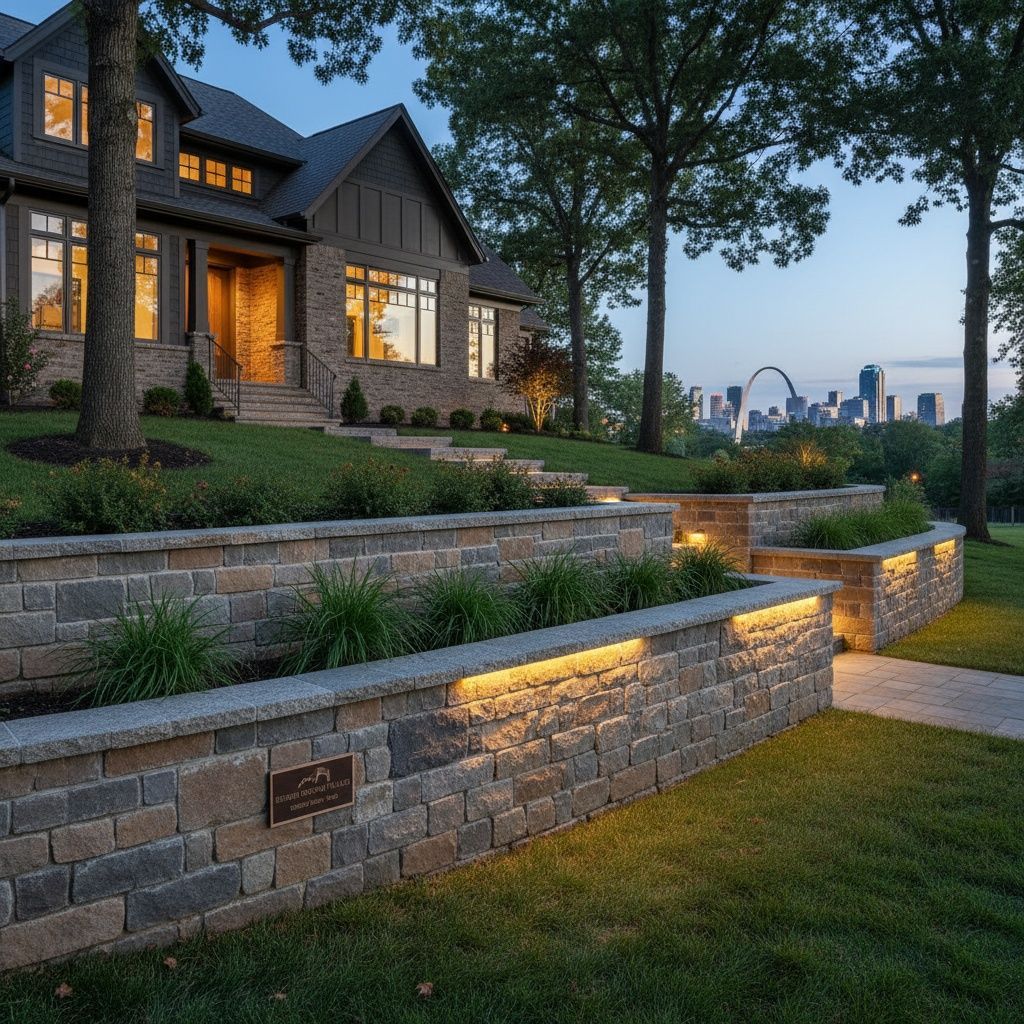
While function is paramount, form is essential. When selecting materials for retaining walls, St. Louis homeowners should choose designs that complement the architectural style of their home. Drawing inspiration from European style stonework, we offer diverse material options.
Natural Stone Walls
Nothing beats the timeless elegance of natural stone. Whether utilizing limestone, sandstone, or granite, natural stone offers a unique texture that manufactured products cannot replicate.
- Dry Stack: A traditional method where stones are fitted without visible mortar, relying on gravity and friction. This offers a rustic, organic look perfect for cottage-style homes in University City.
- Wet Laid: Stones are mortared together for a cleaner, more rigid appearance. This is ideal when matching existing stone brick veneer on your home’s façade.
Segmental Retaining Walls (SRW)
Concrete retaining wall blocks have come a long way. Modern SRW units are engineered to lock together, providing incredible strength for taller applications. They come in various textures that mimic natural stone and are often the preferred choice for structural walls supporting heavy loads, such as a paver driveway or pool deck.
Integrating Hardscapes: Creating Usable Space
The beauty of a retaining wall lies in its ability to turn a problem (a steep, eroding hill) into a solution (flat, usable space). By terracing a slope, you can reclaim your backyard.
The Outdoor Living Extension
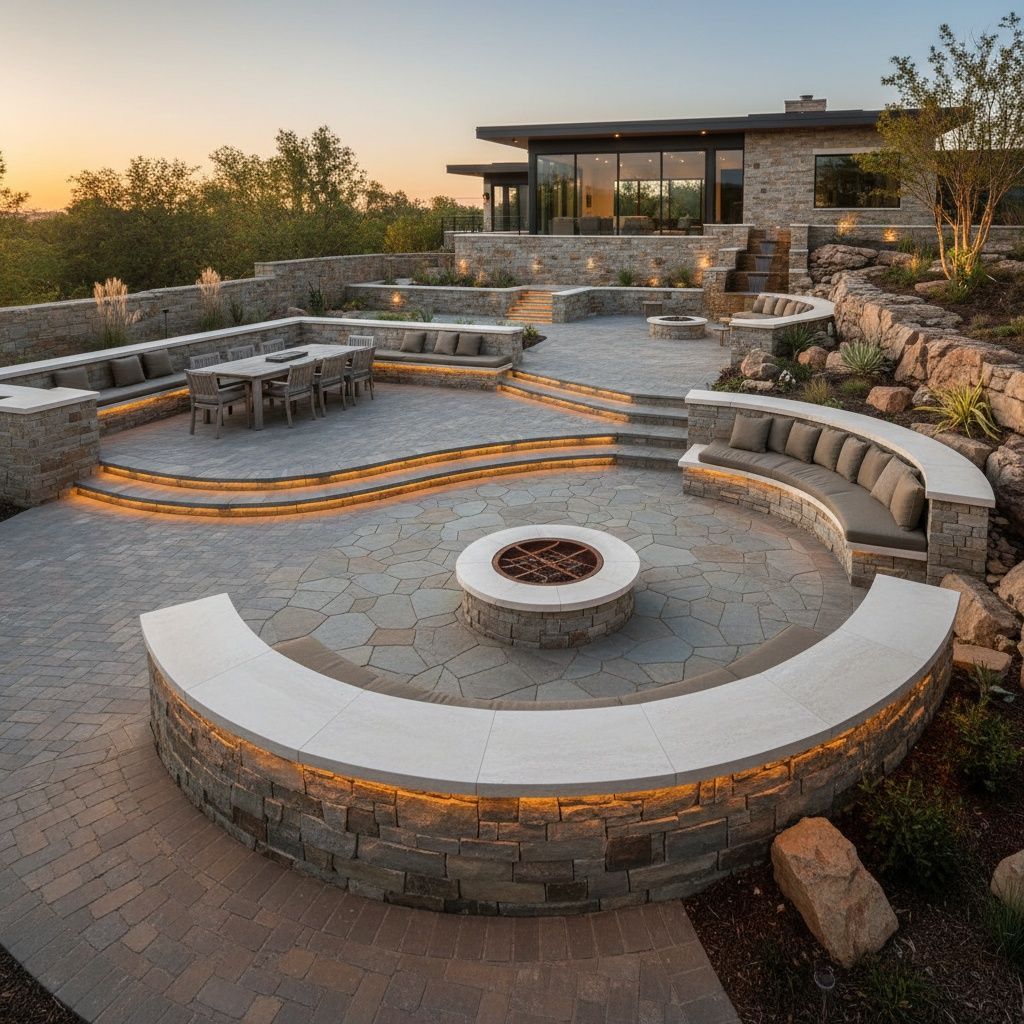
Once the ground is leveled, the possibilities for hardscaping expand significantly. A previously unusable slope can be transformed into a multi-tiered entertainment area.
- Lower Tier: A secluded paver patio featuring a comfortable seating area.
- Upper Tier: An outdoor kitchen or dining space that overlooks the garden.
Connecting the Levels
To navigate these new terraces, we design integrated stone staircases that flow seamlessly from one level to the next. Using stone piers and pillars at the top and bottom of staircases adds a sense of grandeur and provides a perfect location for lighting fixtures.
Local Challenges: Working Across St. Louis Terrain
Every neighborhood in St. Louis presents unique topographical challenges.
In Chesterfield and Ballwin, we often encounter significant elevation changes that require massive, structural walls to support pool decks or driveways. These projects require strict adherence to engineering codes and often involve extensive geogrid reinforcement.
Conversely, in areas like Richmond Heights and Ladue, the challenges are often related to tight property lines and managing water runoff without flooding neighbors. Here, the precision of the drainage system is critical. We ensure that our designs not only protect your property but also comply with local municipal water management regulations.
Expert Tip: The Warning Signs of Wall Failure
If you have an existing retaining wall, early detection of failure can save you thousands of dollars. Watch for these signs:
- Bulging or Bowing: The middle of the wall is pushing out. This usually indicates a lack of drainage and excessive hydrostatic pressure.
- Separation: If the wall is pulling away from the adjacent soil or stairs.
- Clogged Weep Holes: If water isn't coming out of the weep holes during a heavy rain, the drainage system behind the wall may be clogged with silt.
Frequently Asked Questions
Do I need a permit for retaining walls in St. Louis?
Generally, yes. Most municipalities in the St. Louis area, including Chesterfield and Town and Country, require a building permit for walls over a certain height (typically 24 to 36 inches). St. Louis Stone & Brick handles the permitting process, ensuring all engineering specifications meet local codes.
How long does a retaining wall last?
A properly engineered and installed retaining wall should last for decades. Natural stone and segmental concrete walls can last 50+ years. The limiting factor is usually the drainage system; if drainage remains clear, the wall structure will endure.
Can you build a retaining wall that matches my existing brick home?
Absolutely. We specialize in custom masonry. We can source brick or stone that complements your home’s existing stone brick siding, ensuring the new hardscaping looks like it was part of the original architectural plan.
What is the best time of year to build a retaining wall?
While we work year-round, late summer and autumn are often ideal as the ground is drier, making excavation easier. However, getting your project scheduled in winter ensures you are ready before the heavy spring rains cause further erosion damage.
Conclusion: Invest in Longevity
A retaining wall is an investment in the safety and value of your property. It stops the slow destruction of erosion, manages water flow, and creates beautiful new living areas. Don't wait until the next big storm washes away your landscaping. Trust the experts who understand the unique geology of the area to construct the durable retaining walls St. Louis properties need to stand the test of time.
Ready to reclaim your yard and stop erosion in its tracks?
Contact
St. Louis Stone & Brick today for a
complimentary consultation. Let us bring European craftsmanship and modern engineering to your doorstep.
St. Louis Stone & Brick: Your Guide to Timeless Materials